
The Power of Knowing That You Don’t Know
On doubt, humility, and the beauty of an unfinished universe

Certainty is the oldest narcotic. It soothes the restless mind like a lullaby, convincing us that the world is knowable, that meaning is fixed, that someone, somewhere, holds the final answer.
Theism was born from this longing to turn mystery into comfort, chaos into story. To say, There is purpose, and it is ours.
In the East, this longing took subtler shapes. Karma offered a moral physics of its own – every action with its echo, every cause bound to its effect. It was, in its way, an early attempt to make sense of chaos, to find justice in randomness. Yet even karma, for all its elegance, is built on the same desire: to believe the universe keeps score.
In the West, the same yearning took on grandeur, with God as architect, man as design. The heavens were drawn like clockwork: perfect and divine, with Earth at its centre and humanity as its meaning. Creation was not merely origin but validation: proof that we were special, chosen, necessary to the story. Order became sanctity; curiosity, often, a trespass. The search for knowledge was framed as rebellion – Prometheus stealing fire, Eve reaching for fruit, Galileo defying scripture.
For beneath both karma and creation lies a shared human hunger to find pattern in the unknown. One calls it consequence; the other, providence. Both search for laws that can anchor chaos.
Faith, whether in gods or in karma, seeks comfort in the known. Science, on the other hand, finds wonder in the unknown. The believer stops at meaning; the scientist begins there. One builds order to silence uncertainty; the other studies uncertainty until it speaks.
And that is the essential difference. Where religion seeks answers, science seeks better questions.
The story of science, of us, is the story of learning, again and again, that we were wrong.
We once believed the Earth was the centre of everything: immovable, divine, perfectly designed for us alone. Then came Copernicus, who moved us out of the spotlight. Galileo tilted his telescope towards the heavens and saw moons orbiting Jupiter, not us. Newton uncovered invisible forces binding apple to planet, matter to motion. Darwin traced our lineage through finches and fossils, erasing the illusion of human exceptionalism. Einstein folded time and space into a single trembling fabric. Heisenberg showed that reality itself refuses to sit still; that the closer we look, the less certain we become. And Goodall, decades later, watched chimpanzees craft tools from twigs, erasing one more line between instinct and intellect, between them and us.
Each revelation didn’t just expand what we knew; it dismantled who we thought we were.
To know that you don’t know is not ignorance; it’s evolution. It is the mind’s way of remaining porous to mystery. The believer says, Here lies truth. The scientist says, Let’s keep looking.
Every great leap forward began in discomfort – with a mind brave enough to say, This doesn’t add up. Marie Curie’s hands glowed faintly blue before the world understood radiation. Rosalind Franklin saw the structure of life in an X-ray, and no one believed her. Richard Feynman spent a lifetime celebrating “the pleasure of finding things out.” Richard Dawkins reminded us that evolution is not a ladder but a vast, tangled tree; that meaning is not bestowed from above but emerges from the bottom up, through trial, error, and time itself. The Higgs boson, the double helix, plate tectonics, black holes – each was born from disbelief, from the audacity to ask, What if the map is wrong?
Science is not a monument of facts; it is a living act of humility. Every theory carries its own expiry date. Every discovery opens ten new doors of ignorance. To say “I don’t know” is a declaration of freedom; freedom from dogma, from ego, from the human need to crown itself the centre of creation.
The creationist once said, We were made in God’s image. The evolutionist replied, We made God in ours. Perhaps the truth is simpler: hydrogen, given enough time, began to wonder about itself.
What could be holier than that?
To question is to love reality enough to resist simplifications. Skepticism is not the absence of faith; it’s faith in the process that through observation, repetition, and revision, we move closer to truth, even if we never reach it.
We once thought disease came from sin, until Pasteur found microbes. We saw madness as possession, until Freud found the subconscious. We believed the atom was indivisible; until it split, and so did our moral certainty. We thought we’d reached the edge of the universe, until Hubble showed us there is no edge at all.
The more we learn, the smaller we become, and the more magnificent the world grows.
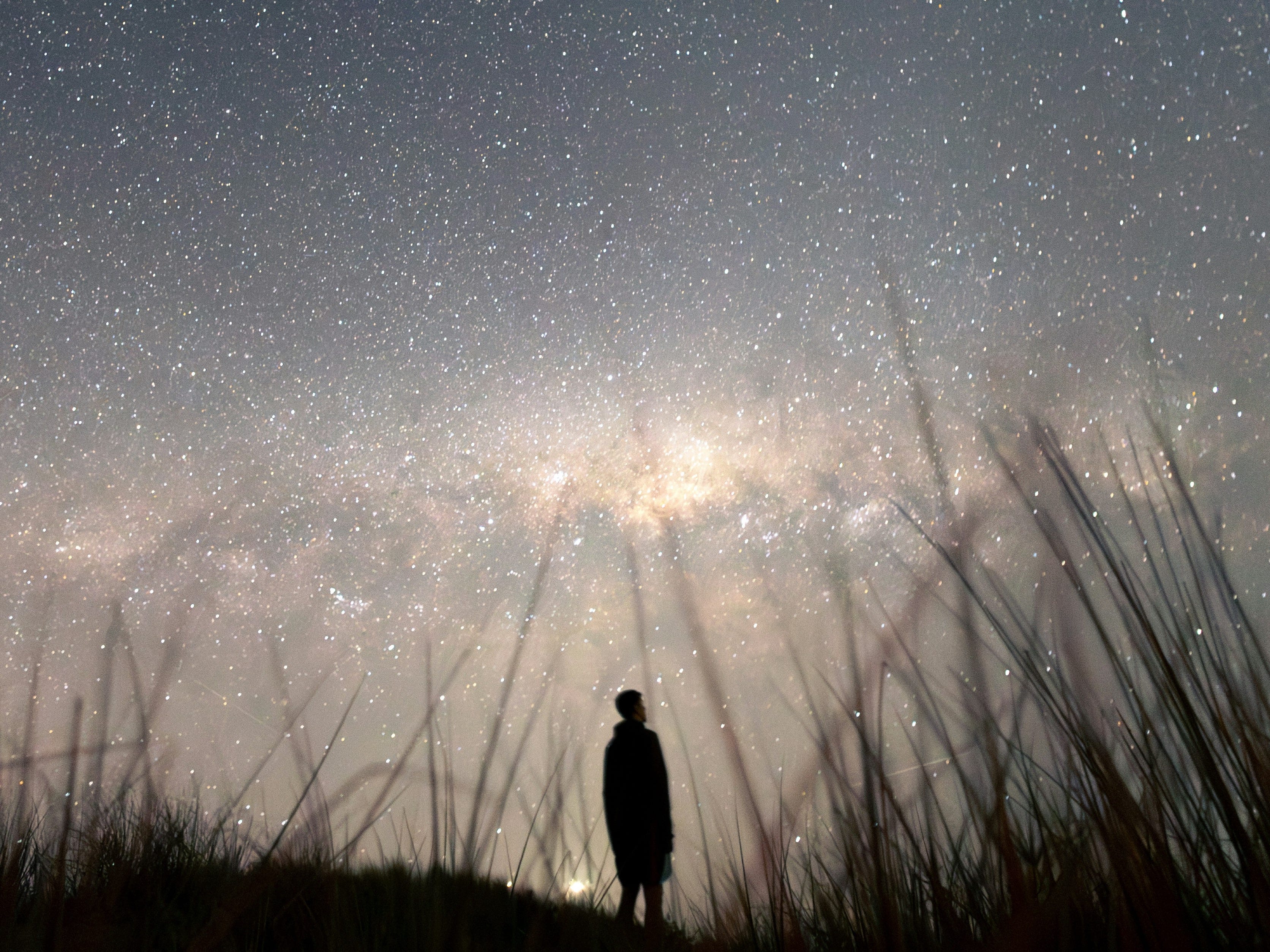
To know that you don’t know is to live with wonder intact: to stand beneath a night sky filled with objects that will outlast us and say, I don’t know what you are but I want to find out.
Because wisdom was never about knowing everything. It was about never mistaking what we know for everything that’s true. And that, the humility to be wrong, the courage to stay curious, remains humanity’s greatest discovery yet. So let us go on – flawed, fleeting, and gloriously uncertain – lighting our little candles of knowledge in a universe that never asked to be known, yet shines a bit brighter because we try.
And if there is any mercy in the cosmos, let it be this: that we never stop being astonished by it.
Such a wonderful profound “ pause moment” to reflect and take strength