
Ladies Problem
The language gap in women’s health

I have a ladies problem. Don’t mind.
No, no, stay. There’s no need to rush for pads and newspapers and black polythene bags.
Good. Now, let’s lower our voices and continue like sensible adults.
This one is not the usual kind. This one requires medical vocabulary. The kind with invasive scans and biopsies and hormone pills.
Very Common
It started with a large fibroid. Very common, they said. Large turned out to mean fourteen centimetres, which feels excessive for something that is supposed to be common. Then they started listing the rest of it, which felt less like a diagnosis, more like qualifications I didn’t apply for. Diffuse adenomyosis. Clap clap clap. Endometrial hyperplasia. Clap clap. Polypoidal endometrium. Clap.
They stared. I guess I wasn’t supposed to clap.
Till then, in my head, my symptoms were perfectly reasonable. Heavy bleeding… happens. Clots… everyone gets them. Fatigue… just a phase.
Finally, after bleeding myself pale for nearly two months, I carried my third-trimester-sized uterus over to the doctor and said, okay, do what needs to be done.
From that point on, the tone shifted from “don’t worry” to “please sign here.”
Then came the service package. Myomectomy. Hysteroscopic polypectomy. D&C. Mirena insertion.
Great, where do I tick?
They smiled. No need. All of the above.
I qualified for the full package.
I am, of course, grateful that we live in a time where something like this can be diagnosed, explained, and fixed without anyone lighting incense and hoping for the best.
So the surgery went well. That is the official summary. The fibroid is gone, the lining is scraped clean, the IUD is in place, the reports look good, the doctor is satisfied, and I have been sent back into the world with the general understanding that everything should now behave itself. For at least five years.
It depends
While the surgery comes with precise words and clear instructions, the aftermath quickly returns to the familiar territory of “it depends.”
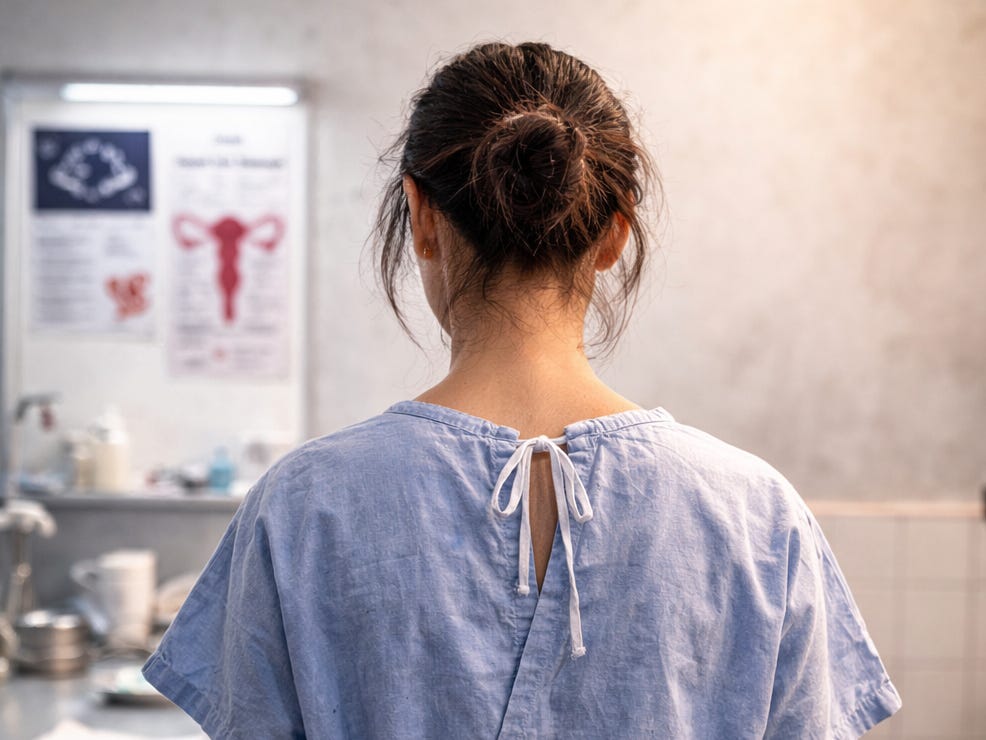
Recovery would take about two weeks, but it’s subjective, they said. Like pain is. Which is reassuring, and also completely useless, because recovery is not a straight line. Eleven weeks post-op, I’m still negotiating with my body like we’ve just met.
What recovery actually feels like is a series of small, humbling discoveries. In the early days, you lie in bed cramping in open protest. Once the pain settles a bit, you realise your abdominal muscles have resigned. Just when you start feeling them again, you discover your pelvic floor has moved out and left no forwarding address. Nothing seems to be where you left it. Your muscles are guarding, everything feels inflamed. Getting out of bed becomes a group activity. Clothes don’t fit, walking becomes a negotiation, and you find yourself leaning on furniture everywhere.
You just figure it out as you go.
That, I’m starting to realise, is the actual recovery plan.
Language gap
The strange part is, none of this is unfamiliar. Not the words, at least.
Fibroids. Polyps. Cysts. Adenomyosis. Hyperplasia. Endometriosis. IUD.
The vocabulary is everywhere. It comes up in conversations here and there. But no one really knows what it is. Or why it happens. Or how it feels. Or how to prevent it.
Women’s health seems to exist in two languages.
One is medical: precise, technical, full of diagrams, and Latin words.
The other is socio-cultural: vague, polite, embarrassing, and private.
Hormonal. Common. Happens. Don’t worry. After thirty. After marriage. After childbirth. After stress. After life.
The medical one tells you what is happening. The social one tells you to keep going. But the two conversations rarely happen in the same place. And between the two, the actual experience slips into shorthand.
We discuss fibroids the way we discuss the weather. We say procedure like it means one afternoon. We say PCOS like it is a category, not an experience.
The problem is not that we speak this way. The problem is that the shorthand is all we have. And the way we talk about these things rarely matches how much space they take up in real life.
Learning sideways
You learn very early that the body is something you manage quietly. You carry the essentials, you track your cycles, you cancel plans, you adjust life, you sit down when you need to, you get up when you have to.
Most of the knowledge about your body comes sideways, from other women, from half-heard advice, from things you notice and never formally confirm.
You learn the logistics before you learn the explanation.
You know how to fold a pad before you know why you bleed.
You know what cramps feel like before anyone tells you what causes them.
So when something bigger happens, you realise how much of this system runs on the assumption that you will adjust. That you will tolerate uncertainty. That you will get used to the new normal without needing every step explained in advance.
And mostly, you do.
You learn how to move in a body that feels different. You learn how to read small signals. You learn which pain matters and which one will pass. You learn to ask fewer dramatic questions and more practical ones.
Is this expected. Should I wait. Should I call. Should I ignore this.
Repair
It’s not that women don’t understand their bodies. It’s that we understand them the way people understand old houses. You know which door sticks, which switch doesn’t work, which pipe makes noise at night. You don’t know exactly why, but you know how to live with it.
And every now and then, something breaks badly enough that you have to call in professionals and get the whole system opened up and repaired.
After that, you get casual reassurances: Everything looks good. You’re fine now. Just give it some time. And you go home a little lighter, a little stitched together, and a little more aware that the manual for this body was never written in one place.
It has been passed down in lowered voices, wrapped in newspapers, wiped with tissues, and stuffed in black polythene bags.
Very common, they say.
And you nod, because you know exactly what that means.