
How to Scatter Yourself Thin
On multitasking and keeping too many things in the air

I’m a sucker for a clean beginning, middle, and end. Stories that feel complete. Things that start with a thrust, move with intention, and arrive somewhere definite. A conversation that concludes. A task that ends. A day that has shape.
I rarely function like that though.
I’m a serial multitasker. But not the simpleton kind – where I make tea while replying to an email while reading an article while eating a meal while watching TV while scrolling Instagram. That is so high school. I’m clearly finishing my doctorate here. Keep up.

I have no issue staying with one thing at a time and being present for hours. Romantic, right? Being present? No one mentions the duration though. Stay present. For how long?
So I switch. Like a bitch. Never pass on a good rhyme, folks.
My beginnings are solid. I plan, I start, I get into it. And then, very reasonably, time slows down and I begin to get fatigued. Something else, equally important, starts to feel very alluring. So I step away, briefly. Just to take a break and do something else.
A break. Such an innocent little vague thing. The break turns into a mood without warning. And then another thing follows.
So nothing overlaps. It just refuses to end – over days, weeks, sometimes months. That’s the doctorate-grade serial multitasking. You follow?
By the time I return, the thing I started with feels like it belongs to a different version of me. I have to re-enter it, remember what I was doing, why it mattered, and reconnect the threads. It gets harder and harder with time.
The week fills up this way, with things that were started with full intention and very little outcome. Everything is now in motion, with no sign of completion. Just stuck in the middle.
Heck, this has now entered my medical records.
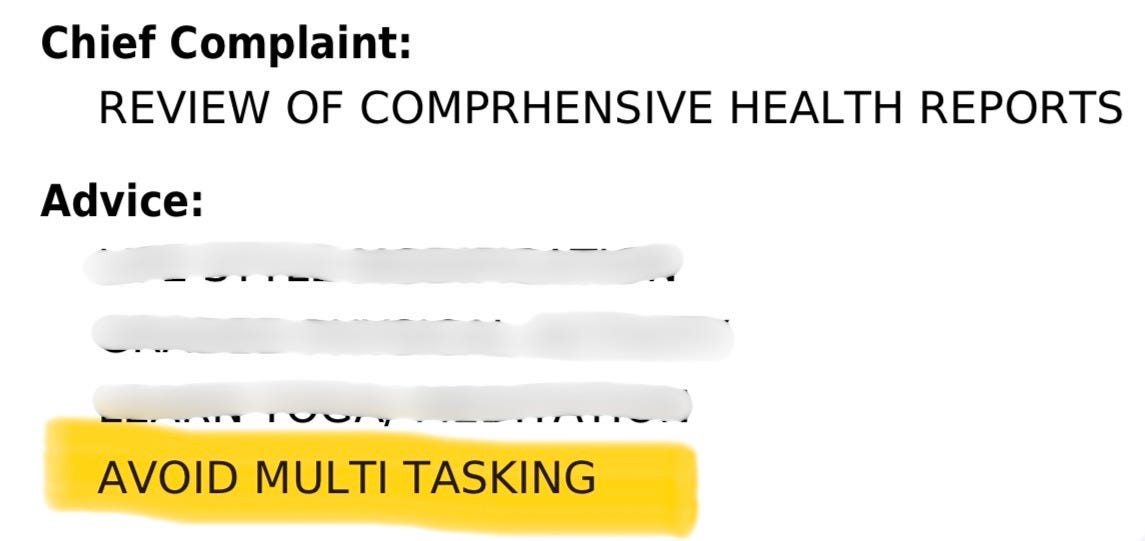
On a recent, completely unrelated consultation, a physician checked my heart rate, reviewed my reports, and wrote on my prescription in firm, confident capitals: AVOID MULTITASKING.
I went in with chronic conditions and came out with this, written alongside some actual medication, as if it were equally measurable and equally doable.
Many thoughts ran through my head as I read that: How did he know? And more importantly, when exactly am I supposed to “avoid” it? Before or after meals? No dosage mentioned.
Not that it matters, but that was my very first visit to this doctor. He didn’t know me well enough to prescribe personality changes. Apparently, he didn’t need to.
But spellings aside, he’s a good doctor. And he was right.
What I’ve been calling efficient is actually expensive.
The brain doesn’t multitask. It switches. And there’s a cost.
Every time you move from one task to another, the prefrontal cortex has to disengage from one goal and reconfigure itself for the next. It feels instant, but neurologically, it isn’t.
Researchers call this a switching cost. It shows up as slower processing, increased errors, weaker working memory, and reduced cognitive depth. Each task gets a thinner slice of your attention.
Every switch can come with a small reward signal, giving a false sense of progress.
And the cost lingers in the form of attention residue.
When you leave a task unfinished, the brain doesn’t fully let go. Mental activity linked to that task lingers in the background, particularly in networks associated with working memory and goal tracking. So when you move on, part of your attention stays behind.
This causes cognitive interference. You’re holding multiple contexts at once. Your brain is trying to resolve one while engaging with another. It’s that low-grade mental clutter. A constant hum of something-else-is-pending.
Multiply that across weeks and months of unfinished tasks, and your brain is basically hosting a really long, dreadful meeting no one is willing to adjourn. Each return becomes a restart. The brain has to reconstruct context and rebuild momentum. Even simple tasks begin to feel heavy.
So my problem is not doing too many things, but leaving too many things open, active, and unresolved. And then carrying them forward, stacking them through the day.
A very efficient way to stay busy, by the way. Just very inefficient for life.
That one line on the prescription doesn’t feel like generic advice anymore. It feels precise.
Let things end. Stay long enough for something to move through its own beginning, middle, and end without interrupting it halfway.
So here’s to medically prescribed restraint. And yet another attempt at reaching the end.